
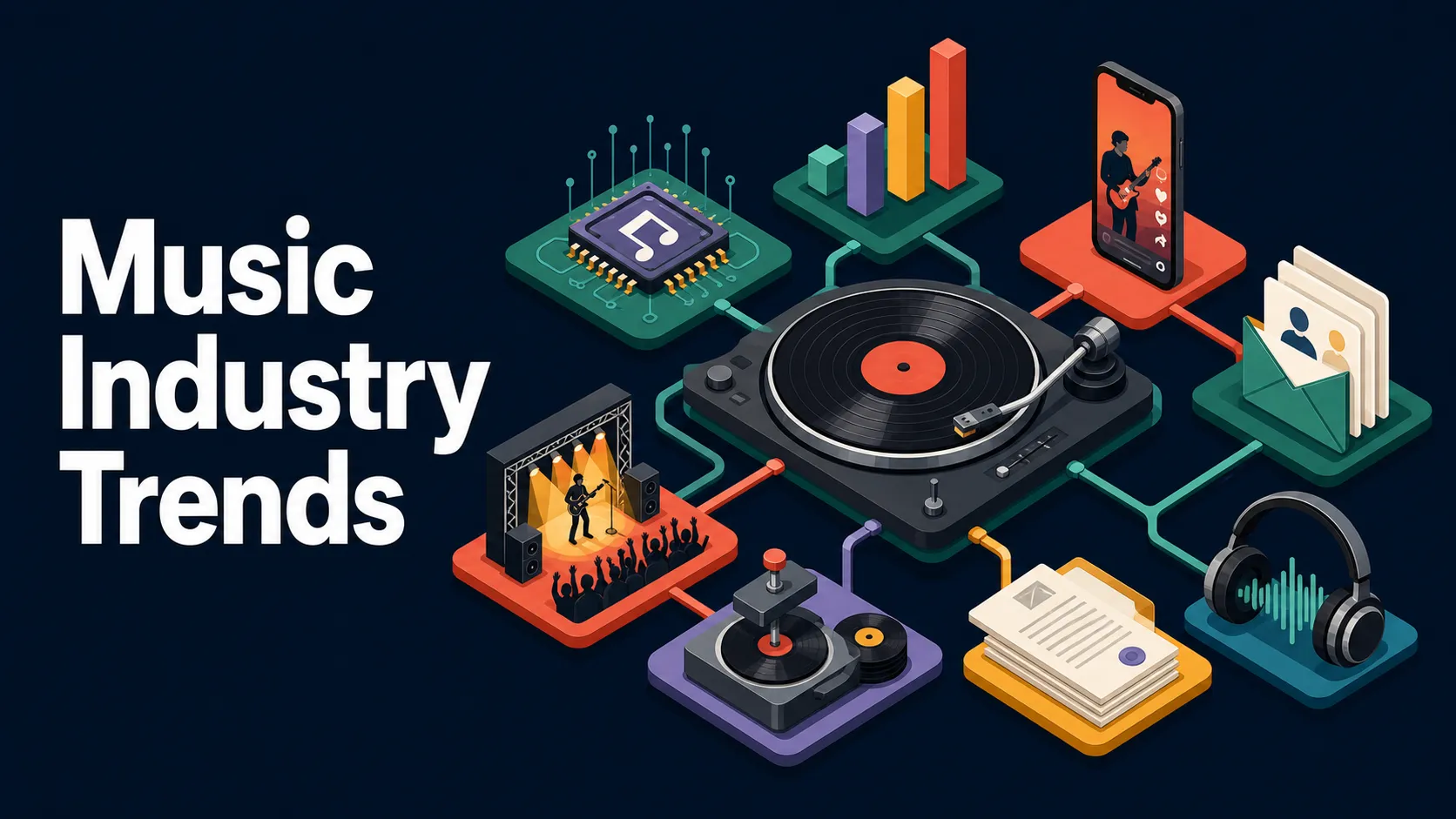
10 Music Industry Trends Every Independent Artist Needs to Know
The rules for making a living from your music changed, and nobody sent a memo. Most artists are still doing what worked five years ago and wondering why it stopped paying.
If you’ve been releasing for a while, you can feel it. Your streams keep going up. Your bank balance doesn’t.
Every “guru” tells you to post more, drop more, grind more. Somehow it never adds up to rent.
Good news: once you see the shifts behind all this, you can stop wasting energy on the stuff that doesn’t work anymore.
Why this matters right now
Music moves faster than the advice does.
AI is in every release pipeline now. Streaming growth flatlined. Live shows became the biggest paycheck for working artists. Direct-to-fan went from buzzword to the thing that actually pays.
The artists who read these shifts early are already pulling away. Six months of doing the right things beats two years of doing the wrong ones really well.
Who this is for
You’re an independent or DIY artist. You release through DistroKid, TuneCore, CD Baby, or someone like them. You run your own socials, your own ads, your own merch.
You’re not signed. You don’t have a manager pushing decks around. You want a real business around your music, not a side hustle that quietly drains your savings.
What you’ll learn
- Why streaming alone stopped paying, and what to lean on instead
- How the AI music flood actually helps real artists (if you play it right)
- The way short-form video rewrote how songs are written
- Why direct-to-fan beats chasing the algorithm
- Why live shows became the biggest paycheck again, and how to tour without losing money
- How to find money your distributor might not be paying you
- The vinyl and cassette comeback, and how to do it without losing money
- What lossless audio means for your next master
- Why genre walls falling is good news if you’re niche
- The growing tier of artists making seven figures from Spotify alone
- Real answers to the questions most artists feel weird asking
Let’s get into it.
The Streaming Plateau Is Real (And It’s Hitting Your Income)
Global recorded music brought in $31.7 billion last year. That’s the eleventh year in a row of growth, per IFPI’s global music report.
Streaming makes up about 70% of that.
So why does streaming feel like it pays less than it used to?
Because total money is up, but per-stream rates are flat to slightly down.
More tracks fighting for the same pool. Bigger catalogs. More AI tracks. Same listeners.
Paid streaming has reached roughly 837M paid subscribers. The market is still growing, but the rich markets are mostly full and growth is in single digits now.
Streaming pays you best when it’s one of four income streams, not your only one. Live, merch, sync, and direct-to-fan aren’t side gigs anymore. They’re how working artists eat.
A Reddit thread from a top-tier producer laid it out plain. He had credits on Offset, John Legend, and Wiz Khalifa tracks.
Total he made from those placements combined: under $10,000.
Most of his actual money still came from teaching piano lessons to five-year-olds.
What to do this month
- Look at where your money actually came from in the last 90 days. List every dollar by source.
- Pick the stream that grew the fastest and put 70% of your effort there next quarter.
- Add one new income source you haven’t tried. Merch, sync pitching, tip jars, anything.
- Stop counting streams. Start counting dollars per fan.
For the full breakdown of how the numbers actually work, our guide on ways to make money with your music goes through each one.
Key takeaway
AI Music Is Flooding Every Platform
Deezer says it’s getting more than 50,000 fully AI-made tracks every day. That’s about one in three new tracks hitting the platform.
Spotify took down 75 million tracks it called spam or low-quality in twelve months. That number is climbing.
Most artists hear this and freak out. Don’t.
When a platform gets flooded with junk, it tightens up. It has to, or listeners leave.
The bar to get surfaced just got higher, and artists who sound like real humans with real stories matter more, not less.
The real shift isn’t the AI tracks. It’s how the platforms are responding: tighter curation, human verification, and more weight on the things AI can’t fake, like save rates, replays, and shares.
What to do this month
- Show your face. Behind-the-scenes clips, voice notes, studio shots. AI can’t fake “you” yet.
- Tell the story behind each release. Where it came from. What it cost you. Who you made it for.
- Build the signals algorithms care about. Saves, replays, and shares matter more than week-one streams. To speed those up, get your music in front of targeted real listeners on Spotify. Avoid anything promising bot streams; that’s what platforms are scrubbing.
- Make sure your artist profile has real photos, a real bio, and verified socials. The artists who skip this are going to disappear.
- If the project has several songs, choose the lead single that makes the clearest first impression instead of the one that needs the longest explanation.
Our Spotify algorithm launch playbook walks through one full release from prep to post-launch.
Short-Form Video Rewrote How Songs Get Written
A song now lives or dies in the first three seconds. That’s the clip window for TikTok, Reels, and Shorts.
The 15-second drop is basically a requirement. The earworm line has to land inside the same window.
Most writers are writing the hook first now, because the hook is the only part the algorithm ever shows people.
One creator who pushed an artist’s track past 500 million organic Instagram views broke down what actually worked. It wasn’t luck.
It was two numbers: hook rate and watch time.
If the first two seconds didn’t stop the scroll, nothing else mattered. If watch time fell under 50%, the post died, no matter how good the song was.
This is also why songs feel so front-loaded now. The slow intro is dead on streaming.
Save your long atmospheric build for the live show, where people are already locked in.
What to do this month
- Front-load your songs. The strongest melodic moment goes in the first eight bars, not in the chorus.
- Make one 15-second clip-ready moment per release. Treat it like a separate asset, not an afterthought.
- Track save rate and replay rate in your distributor dashboard, not just total streams.
- Stop chasing full listens. Chase the first ten seconds of attention.
For tools that help you see what’s actually working, check our roundup of Spotify growth tools.
Direct-to-Fan Is the New Business Model
Pharrell let fans stream a whole album from his own site for free. No paywall.
The catch: the site dropped retargeting pixels for every major social platform.
Then he ran ads back to those same listeners selling merch and vinyl. He reportedly made more from that funnel than from Spotify.
That’s not a one-off. That’s the model now.
Streaming platforms own the connection to your listener. You get top-line numbers, nothing more.
Spotify for Artists tells you 800 people in Chicago played your song. It won’t tell you who they are, or how to reach them when you book a show there.
You need a connection you actually own. Email list. SMS. Discord. Patreon.
The format matters less than the fact that it’s yours.
Key takeaway
Here’s what the real difference looks like.
| Platform-dependent reach | D2F-owned relationship |
|---|---|
| You see counts, never names | You see names, emails, locations |
| Algorithm picks who sees your post | You pick who gets your message |
| Income depends on per-stream rates | Income depends on what you sell |
| If the platform pivots, you lose access | You keep the list forever |
| Hard to make money per fan | Easy to make money per fan |
MIDIA Research has tracked this for years.
The artists who built real D2F systems early are the ones least hurt now that per-stream rates are dropping.
What to do this month
- Put a free download or unreleased demo on your link in bio. Trade it for an email.
- Send your list one email every two weeks. Voice notes, studio updates, presale links, whatever.
- Put your most loyal fans in a paid tier. $5 a month with three perks is enough to start.
- Stop posting to grow follower counts. Post to grow your list.
One honest note: D2F only works if new ears keep showing up.
The owned list is the bottom of the funnel, not the top. Playlist exposure feeds listeners in so you can convert the ones who care.
Start with free playlist submission if you’re early. Look at curator-driven playlist placement once you have a release that’s ready to scale.
Live Shows Are the Biggest Paycheck Again
Global live music is on track to clear $35 billion. For most working artists, a live ticket is the biggest single line in their income now.
But mid-tier touring got harder, not easier.
A long thread on r/musicindustry broke it down. Ticket and production costs are up. Venue cuts are up. Fees on every line.
Bands that used to break even on club tours are losing money on them now.
The answer isn’t to skip touring. It’s to stop touring like you’re on a major label.
Build city by city. Play the same five rooms until you can fill a 300-cap one.
Skip the cities where you have ten monthly listeners and don’t call it a national tour. Build a merch table that actually makes money.
For the wider picture, Pollstar and IQ Magazine track the live business in detail.
What to do this month
- Open Spotify for Artists and pull your top 10 cities by monthly listeners.
- Book your next four shows only in cities with at least 500 monthly listeners. Not there yet? Most indies hit those numbers by stacking release consistency with targeted listener growth in their best regions, not by waiting on the algorithm.
- Set a merch margin floor of 60%. If a shirt won’t clear that, don’t print it.
- Sell direct from your site, not just at the show. Grab the email at the merch table.
Our piece on real touring economics goes through the numbers line by line.
Your Distributor Might Not Be Paying You Right
This one’s uncomfortable. Read it anyway.
A Reddit user posted a story that went around. He had a song with 300 million YouTube Shorts views. His distributor reported back royalties of about €4,000.
Something felt off. He hired an independent auditor.
The audit came back showing roughly €26,000 in unreported royalties. After the recovery, he was paid the full €30,000.
This isn’t a one-off. The Trichordist has been publishing per-source royalty data for years, and the numbers swing wildly depending on the layers in between.
What to ask your distributor
- Can you send me a line-by-line breakdown of royalties by source (Spotify, YouTube Shorts, TikTok, Facebook, etc.) for the last four quarters?
- What’s your typical reporting lag for each source, and where do you see the biggest gaps?
- Do you support a third-party audit on artist request?
If you can’t get clear answers to all three, that itself is your answer.
For the practical registration side, our music royalties explained guide shows which accounts independent artists usually need before a song starts earning.
What to do this month
- Pull your last 12 months of royalty statements into a spreadsheet.
- Cross-check the reported streams against Spotify for Artists and YouTube Studio.
- Flag any source where the dollars are more than 20% off from what public per-stream rates would predict.
- If something looks wrong, ask. If the answer is vague, push harder.
Vinyl and Cassettes Came Back (And They Pay Better Than Streaming)
Vinyl has been climbing for over a decade. Cassettes quietly came back too, especially with younger fans. CDs are even creeping back in some genres.
Why?
A long Reddit post nailed it better than any industry report.
Streaming pulled every bit of friction out of listening. Songs get judged in three seconds. Albums barely stand a chance. People learned to skip, scroll, and forget.
Listeners pushing back are picking up physical stuff on purpose. Not because they want better sound.
They want a moment that feels like it matters.The RIAA’s year-end revenue data backs it up. Physical is small next to streaming, but it grew while streaming growth slowed.
For an indie artist, physical isn’t about chasing a trend. It’s about margin and meaning.
A 7-inch single might cost you $3 to press in a small run and sell for $15 to a fan who already loves you. A cassette costs $2 and sells for $12.
A limited run sells out way faster than an unlimited one.
Quick margin math
| Item | Cost per unit (small run) | Sells for | Margin |
|---|---|---|---|
| Cassette (100 unit run) | $2 to $3 | $10 to $15 | 70% to 80% |
| 7-inch vinyl (200 unit run) | $5 to $7 | $15 to $20 | 60% to 70% |
| 12-inch LP (300 unit run) | $9 to $13 | $25 to $35 | 60% to 65% |
| CD-R limited edition (100) | $1 to $2 | $10 | 80% to 90% |
Numbers shift with country, packaging, and supplier. Either way, the margin per fan is way better than streaming.
What to do this month
- Pick one upcoming release. Add a 100-unit cassette or 7-inch run.
- Sell it from your own store, not through your distributor, so you keep the margin and the email.
- Number every copy by hand. Friction is the whole point.
- Cap the run. Scarcity is what makes it work.
Lossless Audio Just Became the New Floor
Spotify rolled out lossless streaming to Premium across more than 50 markets. The format is 24-bit, 44.1 kHz FLAC. Apple Music, Tidal, and Amazon already had it.
Most fans can’t hear the difference on AirPods or a phone speaker. That’s not the point.
The floor just got higher, and the master file you turn in needs to match.
If your mastering engineer is still sending you only a 16-bit WAV, you’re publishing at the floor while everyone else is at the ceiling.What to do this month
- Ask your mastering engineer for both a 16-bit and a 24-bit master on your next release.
- Make sure your distributor accepts and delivers the hi-res version to platforms that take it.
- Stop uploading MP3 masters. It’s the cheapest mistake you can keep making.
- Watch your loudness. Streaming normalization makes overly hot masters sound worse, not louder.
For more on the metric debates, our piece on Spotify followers vs monthly listeners digs into what actually moves the algorithm.
Genre Walls Are Gone
Listeners don’t browse by genre anymore. They browse by mood, activity, and vibe. “Songs for a rainy drive home” pulls way more clicks than “alt-pop.”
This shift changes what goes in your bio, your metadata, and your marketing.
If you’re a niche artist, this is good news. You don’t need to fit in a box. You need to be findable for a feeling.
A bedroom-pop artist with a sad-coffee-shop vibe competes against every other sad-coffee-shop track. That’s a smaller, more winnable fight than “indie pop on Spotify.”
What to do this month
- Rewrite your bio around a feeling, not a genre. Three sentences. Save the genre tags for metadata.
- Add three mood-based hashtags or playlist tags to your release plan. “Late night driving” beats “synth-wave” for discovery.
- Pitch mood-based playlists, not genre-locked ones, on your next track.
- Find crossover curators. Less competition, more attention per slot.
This is also why promotion targeting behavior (what people actually listen to) outperforms promotion targeting genre tags.
If you’re running ads or working with someone who does, ask how their targeting works. Behavior-based Spotify promotion lines up with how listeners discover music now.
The “Career Artist” Tier Is Bigger Than It’s Ever Been
Here’s the number nobody talks about enough.
More than 1,500 artists made over $1 million in royalties from Spotify alone last year.Spotify publishes this on its Loud & Clear site if you want the full breakdown.
That number used to be a few dozen. It’s a real tier now.
A new middle class of indie musicians is forming. Not arena fillers. Not viral one-hit kids.
Steady working artists with multiple income streams, an audience they own, and a steady release pace.
So what’s the difference between the artists in that tier and artists with similar streaming numbers who still can’t pay rent?
Three things, done for years.
- They release often. Multiple drops a year, not one every eighteen months.
- They spread their income. Streaming is one stream, not the stream. Merch, live, sync, D2F.
- They own their fans. Email list, ticket buyer data, repeat-buyer data, all of it.
That’s the playbook. Not magic. Not luck.
Just three habits stacked for a few years.
You can get there. The artists already in that tier didn’t do anything you can’t.
Our launch playbook walks through one full release cycle that fits this model.
Frequently Asked Questions
Real questions from real artists, pulled from r/musicindustry and r/WeAreTheMusicMakers.
How much can an indie artist actually make from streaming?
Short answer: not much, unless you’re doing huge numbers.
- Per-stream rates: $0.003 to $0.005, depending on country and account
- 1 million streams: $3,000 to $5,000 (before splits with producers, mixers, distributor)
- 50 million-plus streams a year: this is where streaming starts to feel like real income
For most indies, streaming pays for gear and software, not rent. Treat it as a discovery channel that pays a small bonus, not as your income.
Is it still worth releasing on every platform if streaming barely pays?
Yes, but stop calling “everywhere” a strategy.
Being on every platform is the floor, not the plan. Here’s a better split:
- Spotify plus one of YouTube, Apple Music, or SoundCloud, depending on your genre. Put your release energy here.
- Everywhere else. Let your distributor handle it. They’ll add a few extra bucks for no extra work.
Skip the obsession with massive multi-platform launches. They’re a treadmill.
Should I be worried about AI music taking over Spotify?
Not the way most artists fear it.
Yes, AI tracks are flooding the platforms. But two things are happening at once:
- Platforms are tightening their curation
- Fans are getting better at spotting low-effort junk
The risk isn’t AI replacing you. The risk is making music so generic that AI can replace it.
Lean into what AI can’t do yet: your face, your story, your live show, and your relationship with fans.
How do I know if my distributor is paying me correctly?
Cross-check your payouts against Spotify for Artists and YouTube Studio.
- Streams match, dollars feel low? Run the math against public per-stream rates.
- Streams themselves don’t match? That’s a bigger flag.
- Ask for a line-by-line breakdown by source for the last four quarters.
If your distributor can’t or won’t send it, that’s your answer. Independent royalty audits exist for a reason, and they’ve gotten artists serious money back.
What matters more now: streams, followers, or fans?
Fans, by a mile. Here’s the difference:
- A fan opens your email, buys your merch, and shows up to your show
- A follower might never see your post again
- A streamer might never play you again once the algorithm moves on
Streams are a discovery metric. Followers are social proof. Neither is a business. Fans are the business.
Build the list. Build the relationship. Turn streams and followers into fans you actually know.
The Real Takeaway
The artists making a real living from music right now all share one habit.
They treat it like a small business, not a hobby they’re hoping gets discovered.That sounds boring. It’s not. It’s the most freeing thing you can do as an indie artist.
Once you stop waiting to be discovered, you start running the playbook:
- Spread your income across streams, live, merch, sync, and D2F
- Check your distributor instead of trusting the report
- Build an audience you own (email list, SMS, Discord)
- Front-load your songs so they survive the three-second window
- Ship physical for fans who want a real object
- Play the cities where you already have listeners
None of it is glamorous. All of it works.
The big music industry trends shaping the next ten years aren’t really about AI or vinyl or short-form video. They’re about ownership.
The artists who own their audience, their data, their margins, and their pace are the ones still getting paid no matter what the platforms do next.
If you want to see one full release cycle with all of this in mind, our Spotify algorithm launch playbook walks through it step by step.
Take what fits. Skip what doesn’t. Then ship something next month.
That’s the whole game.