
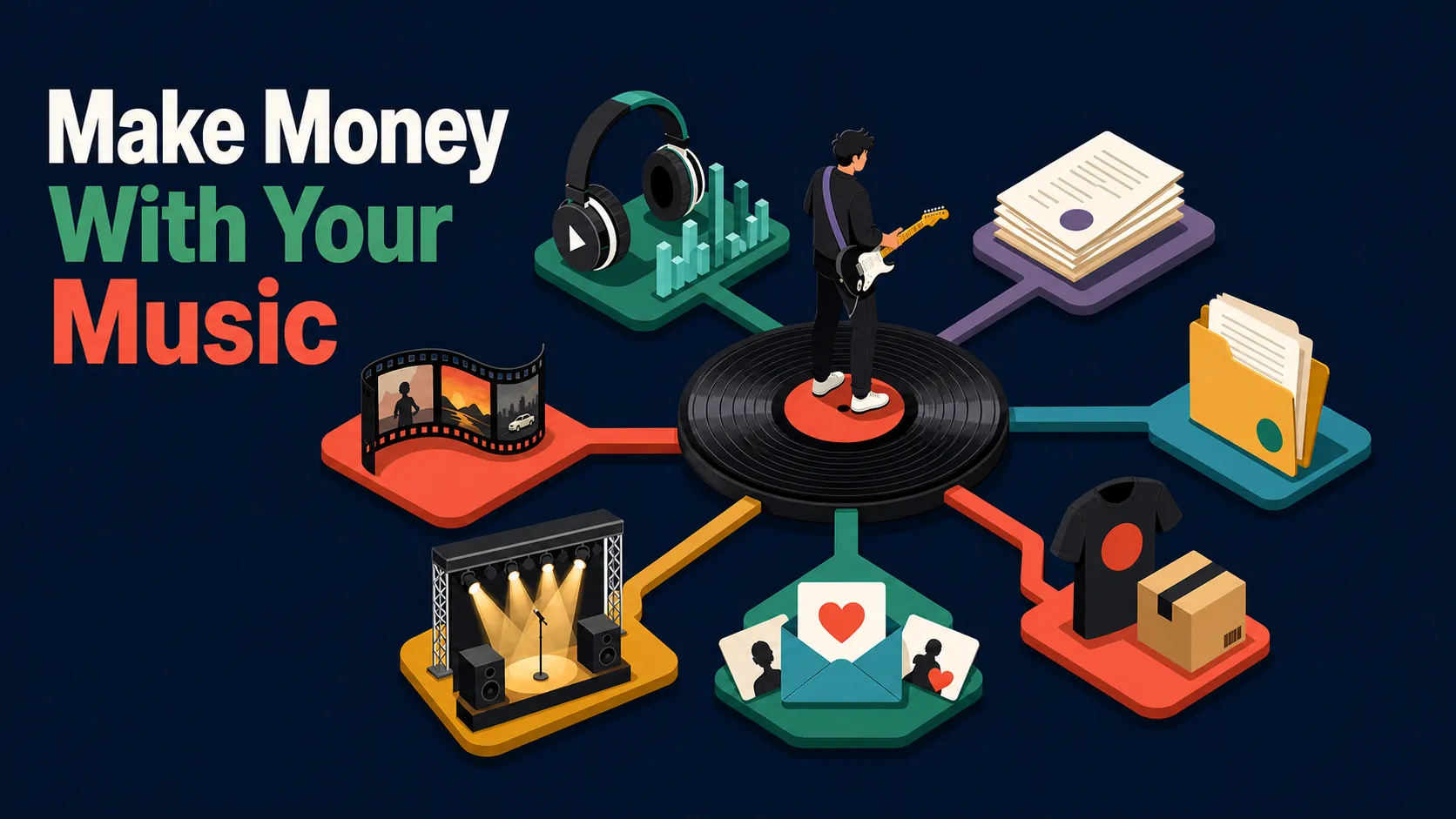
Make Money With Your Music: A Practical Playbook For Independent Artists
You can have a million streams and still not afford rent.
Ask anyone who has actually been there.
The painful part is not that the money is small. It is that nobody told you the math before you spent three years chasing the wrong number.
Streams pay you in pennies. Real music income comes from a handful of things stacked together, and nobody bothers to explain how that stack actually works.So that is what this is.
Not “27 ways to monetize your passion.” Not a pep talk. A real walkthrough of where the money lives, who pays it, what it actually pays, and what to go do this week.
Why streaming feels like a scam (and kind of is)
Spotify pays around four tenths of a cent per stream in most markets.
That is 250 streams to make a dollar.
If you are sitting at 10,000 monthly listeners and wondering why your bank account looks the same as before you released, this is why. The number is real. You did the work. The platform just does not pay much for the work.
Spotify is not your paycheck. It is your billboard.
The artists making real money treat streaming the same way a chef treats Yelp reviews. It matters. It is not where the meals get sold.
This is for you if
- You release your own music (or are about to).
- You own at least some of it.
- You are not waiting around for a label to save you.
You want a straight answer to one question: where does the money actually come from, and what do I do first?
What you’ll get out of this
- The full map. Every real way artists earn from their music, with what each one pays.
- The royalty stuff nobody explains. Two completely different paychecks come off every song you release. Most artists collect one and never see the other.
- Sync, demystified. The single placement type that can pay more in one shot than a year of streams.
- The fan economy. Bandcamp, Patreon, merch, and the email list nobody bothers to build.
- Live money, for real. What gigs actually pay, what nobody tells you about touring, and where the real money hides.
- A 90 day plan. What to do first, second, and third.
Where music money actually comes from
Every dollar a musician earns lands in one of five buckets.
If you are only touching one or two, you are not broke. You are unfinished.
| Bucket | What you are selling | Who is paying | How fast it pays |
|---|---|---|---|
| Your recordings | Plays, downloads, syncs of the master | Streaming platforms, sync buyers | Fast for streams, slow for sync |
| Your songwriting | The underlying song itself | PROs, the MLC, sync buyers | Slow, but pays for years |
| You, live | A show | Venues, promoters, weddings, brands | Fast once you get booked |
| You, direct | Merch, vinyl, memberships, downloads | Your actual fans | Fast, best margins in the whole game |
| Your skills for hire | Teaching, sessions, production, beats | Other artists, students, brands | Fast, but you stop earning when you stop working |
The trap most artists fall into is living in one bucket forever.
The bedroom producer who only chases streams. The cover band that only plays Saturdays. The teacher who only teaches. Every one of them is one bad month away from rethinking everything.
Your career is not one revenue stream that grows. It is three or four small ones that keep each other alive while the catalog builds.
Streaming: the slowest dollar in the room
Streams will not pay your rent. They will pay for the things that do.
That is the right frame.
Public payout data from Spotify’s Loud and Clear report and the broader platform tracking lines up roughly like this:
| Platform | Per stream payout (rough) | What it is actually good for |
|---|---|---|
| Spotify | ~$0.003 to $0.005 | Discovery. The biggest audience on earth. |
| Apple Music | ~$0.007 to $0.010 | Pays better per stream, smaller crowd. |
| Amazon Music | ~$0.004 to $0.008 | Quietly important, especially globally. |
| YouTube Music | ~$0.002 | The low end. The ad layer is the real prize. |
| Tidal | ~$0.012 to $0.015 | Best per stream, tiny audience. |
| Pandora | ~$0.001 to $0.002 | US heavy, soft money. |
And remember: that is what hits the rights holder. By the time it has run through your distributor and any splits, the number you see is smaller.
What that means for you
Want to know what your streaming income would actually look like at different goals? Just divide.
streams needed = what you want / your blended rate
A blended rate of $0.004 per stream is normal for most independents.
| If you want to make | You need streams |
|---|---|
| $100 a month | 25,000 |
| $1,000 a month | 250,000 |
| $10,000 a month | 2.5 million |
| A full time living ($50k a year) | 12.5 million |
Look at that 12.5 million number again.
That is roughly 300,000 to 800,000 monthly listeners, every month, forever, just to clear $50k from streams alone.
If your plan is “get good enough on Spotify and the money will follow,” you have just signed up for a brutally hard business with the worst margins in entertainment.
So why bother streaming at all?
Because nothing else on this list happens without it.
Streaming is how a stranger discovers you. Streaming is how Release Radar sends your next song to the people who already follow you. Streaming is what gives a sync supervisor a reason to listen when you pitch.
The trick is not getting more streams.
It is making sure the streams you do get turn into something else: a save, a follow, an email signup, a Bandcamp visit, a ticket. We dug into that whole conversion problem in Spotify followers or listeners.
If you want help making the streams happen in the first place:
- Run a proper launch. Most artists waste a release week by not knowing what signals the algorithm is actually watching for. Our Spotify algorithm launch playbook lays out exactly what to do and when.
- Promote to the right people, not just more people. Cheap traffic is the most expensive thing you can buy. Our Spotify promotion and playlist placement are built around getting your song to listeners who actually fit it.
- Find out where your profile is bleeding. The free Spotify audit tells you in a few minutes.
The royalty money you are probably leaving on the table
Now we are into the part that actually frustrates me when I talk to artists.
Every song you release generates two different paychecks.
One is for the recording, the thing people press play on. The other is for the song itself, the melody and the words. They get paid by different people, collected in different places, and most artists never set up the second one.
So they leave thousands on the table, year after year, while complaining that streaming does not pay enough.
If you want the full breakdown before you register anything, read our music royalties explained guide first.
| Type of royalty | What it pays for | Where to actually go collect it |
|---|---|---|
| Master recording | Streams and downloads of your specific recording | Your distributor handles this |
| Mechanical | Reproductions of the underlying song (streams count as reproductions) | The MLC in the US, your publishing admin everywhere else |
| Performance | Public play of the song (radio, TV, streaming, venues, restaurants) | Your PRO: ASCAP, BMI, SESAC, or your country’s equivalent |
| Digital performance | Non interactive digital play of your recording (internet radio, SiriusXM) | SoundExchange |
| Sync | Use of your song in film, TV, ads, games | Direct, or through a sync library or agent |
| Neighboring rights | International broadcast and public play of your recording | A neighboring rights administrator |
Go do this today
Seriously, today. None of this is hard. Most artists just never get around to it.
- Sign up with a PRO. ASCAP or BMI in the US. Register every song you wrote.
- Sign up with the MLC. If you self publish in the US and you are not signed up here, you are leaving mechanical royalties on the table right now.
- Sign up with SoundExchange. Same story for digital performance royalties.
- Pick a publishing admin or use your distributor’s. Just do not have both running and collecting. That gets ugly.
- Get registered for neighboring rights if your music gets any play outside the US.
- Register your important songs with the US Copyright Office. Especially anything you might license or pitch.
I am not exaggerating: I have watched artists do this in one afternoon and unlock $800, $1,200, sometimes more in back royalties they had no idea existed.
Key takeaway
Sync: the one placement that can change your year
Now the fun part.
A sync placement is when your song gets used in a video. Could be a TV show, a film, a commercial, a game, a YouTube ad, a TikTok campaign by a brand.
The reason every artist should care about sync, even bedroom producers:
One placement can pay more than a year of streams.
And it pays in three places at the same time:
- The sync fee itself (the upfront check).
- The master use fee for using your specific recording.
- The performance royalty every time the thing airs, which keeps trickling in for years.
That is why your favorite indie artist who had a song in a Netflix show seemed to disappear for three years and then bought a house.
What sync actually pays
This is messy. Every deal is negotiated. But here is what is realistic in the wild:
| Where it landed | Typical fee |
|---|---|
| Small YouTube creator or brand video | $250 to $2,000 |
| Indie film at festivals | $500 to $5,000 |
| Background music in a streaming show | $2,000 to $15,000 |
| TV ad spot | $5,000 to $25,000 |
| A real moment in a TV show (montage, big scene) | $15,000 to $80,000 |
| National ad campaign | $25,000 to $250,000 and up |
| Movie trailer | $20,000 to $100,000 and up |
| Used in a video game | $1,000 to $30,000 |
What gets you placed (and what gets you ignored)
Music supervisors get pitched by everyone. You have about ten seconds to not get deleted.
What works:
- You can tell them in one line who owns what. If clearing your song is going to involve six phone calls, they move on. Period.
- You have an instrumental version. Vocals often clash with dialogue. No instrumental, no placement.
- You can send stems. Lets them edit your song to picture instead of fighting it.
- You write in a sync friendly lane. Cinematic, indie pop, alt, hip hop instrumentals, acoustic, ambient. If your stuff fits a scene, you have a shot.
Where to start
Pick one of these. Do not try all three at once.
- Pitch supervisors directly. Hardest. Slowest. Pays the most when it hits.
- Submit to non exclusive libraries. They pitch on your behalf, take a split, you keep the song free to license elsewhere.
- Sign exclusive to a library. They work the song harder because they have to. But you cannot use that song anywhere else.
YouTube is two businesses, and you are probably only running one
Most artists upload their music to YouTube through their distributor and call it done.
That is half the business.
The other half is Content ID, the system YouTube uses to find your music in other people’s videos and put ads on those videos, then pay you a share.
| The YouTube you know | The YouTube you are sleeping on |
|---|---|
| Your songs on YouTube Music and your Topic channel | Every video on the platform that uses your song |
| Per stream payouts via your distributor | Ad revenue split via Content ID |
A song that gets used in a dance trend, a fan edit, a workout playlist video, or a TikTok cross posted to Shorts can quietly earn you ad revenue for years.
But only if Content ID actually has your fingerprint.
What to actually do
- Make sure your distributor enrolls you in Content ID or sign up with a dedicated partner.
- Claim your official artist channel and link it to your releases.
- Upload an official audio or lyric video for every release. Costs nothing, earns forever.
- Use Shorts to feed your main channel. Shorts pay almost nothing. The long form views and subs they generate do.
If you want help running real YouTube growth (not just buying random views), our YouTube promotion is built around matched viewers, not vanity metrics.
Setting up Content ID is one afternoon. The money it unlocks is forever.
Where the real margins live: your actual fans
This is the part of the conversation most artists skip because it does not feel cool.
But here is the math that should change how you think about everything:
- One $10 album sale on Bandcamp puts about $8.50 in your pocket.
- To make that same $8.50 from Spotify, that fan needs to stream you roughly 2,000 times.
Two thousand streams. From one fan. To equal one sale.
That is not a typo.
If you have 100 real fans who would buy a record from you, you have more value than 100,000 strangers who heard you in a playlist.Bandcamp
Bandcamp is still the cleanest direct sale you can run. Set your own prices. Sell digital, vinyl, cassettes, bundles. On Bandcamp Fridays they waive their cut and almost everything goes to you.
What people earn on it tracks almost perfectly with how big their email list is and how often they release.
| Type of artist | Realistic monthly Bandcamp |
|---|---|
| Hobbyist, no list | $0 to $25 |
| Niche act, 500 to 1,000 real fans | $200 to $1,500 |
| Active artist with consistent releases | $1,500 to $8,000 |
| Cult artist with real fan culture | $8,000 to $30,000 and up |
The artists doing $5k a month on Bandcamp are not magic. They release often, they email their list, they bundle, they do limited drops, they make the page feel like a place worth visiting.
Memberships (Patreon and friends)
The “1,000 true fans” idea still holds.
| What each fan pays a month | What 1,000 of them is a year |
|---|---|
| $5 | $60,000 |
| $10 | $120,000 |
| $25 | $300,000 |
A thousand fans is not a fantasy. It is achievable. The artists who pull it off do two things:
- They give people a reason to be inside. Not just “early access to releases.” Demos in progress, voice notes, livestreams, sample packs, group chats, behind the scenes stuff. It should feel like a room, not a discount code.
- They treat the inside like a small audience, not a tier list. The wall has a reason. You talk to the inside differently than the outside.
The email list nobody wants to build
I know. Email is boring.
Email is also the only audience asset on the entire internet that nobody can take from you.
Spotify changes its algorithm? Your email list is fine.
Instagram throttles your reach? Your email list is fine.
Your label drops you? Your email list is fine.
Every release, every show, every drop should be feeding your list. The simplest version:
- Offer something specific in exchange. A free EP, an unreleased demo, a sample pack, presale window for the next vinyl.
- Email at least once a month. Not a press release. Talk like a person.
- Always end with one thing to do. Stream the single. Preorder. RSVP. Share.
Key takeaway
Merch is not “shirts at shows” anymore
Print on demand changed this. You do not need to front $3k on inventory anymore.
| Item | Cost | Sell for | You keep |
|---|---|---|---|
| Shirt (print on demand) | $9 to $14 | $28 to $35 | $14 to $25 |
| Shirt (bulk screen printed) | $5 to $8 | $25 to $30 | $17 to $25 |
| Hoodie (bulk) | $18 to $25 | $50 to $65 | $25 to $40 |
| Vinyl LP (small pressing) | $12 to $18 | $28 to $40 | $10 to $22 |
| Cassette | $4 to $7 | $12 to $18 | $5 to $11 |
| Digital bundle with extras | $0 | $10 to $30 | $9 to $28 |
| Signed test pressings, limited stuff | $20 to $50 | $80 to $250 | $30 to $200 |
One $30 shirt sale is roughly the same income as 5,000 streams. Let that sit with you the next time you are watching your stream counter.
Playing live: still the biggest single check most nights
For most working independent artists, live is still the biggest line on the income spreadsheet.
It is also exhausting, messy, location dependent, and bizarrely under negotiated by almost everyone.
| What you are playing | What it usually pays |
|---|---|
| Local opener at a small bar | $0 to $100 plus drink tickets |
| Local headliner at an established room | $200 to $800 plus a door split |
| Regional touring opener | $100 to $400 plus per diem |
| Regional headliner with an actual draw | $500 to $2,500 plus merch |
| Festival side stage | $500 to $5,000 |
| Festival main stage | $5,000 to $50,000 and up |
| Wedding gig | $1,500 to $6,000 |
| Corporate event | $2,000 to $25,000 |
| House concert | $500 to $3,000 plus merch |
Sixty to a hundred shows in a year is normal for a working independent. That puts you somewhere between $25k and $80k from live alone, before merch.
Merch at the show often becomes the bigger half of the night. That is not a metaphor. Some bands tour at break even on guarantees and pay the rent off the merch table.
The cost stack is what kills people: van, gas, lodging, sound, broken gear, paying the band. Profitable touring is mostly about smart routing, not bigger venues.
Services: the bridge that funds the catalog
The catalog is the long game.
Services pay the bills while the catalog grows.
| What you can sell | Typical pay |
|---|---|
| Lessons (private, group, online) | $30 to $150 an hour |
| Session work (playing on other people’s songs) | $50 to $5,000 a song |
| Producing for other artists | $200 to $5,000 a project, plus future splits |
| Beat sales (leased and exclusive) | $20 to $500 leased, $500 to $10,000 exclusive |
Services should fund your release schedule, not replace it.
If you are spending all your hours producing for other artists and not releasing your own music, you are running a small business, not building an artist career. Both are fine. Just be honest about which one.
What a real artist income breakdown actually looks like
Forget the streaming dreams. Here is what a working independent artist clearing roughly $55k a year actually pulls in:
| Where the money comes from | A year |
|---|---|
| Live (about 60 shows) | $22,000 |
| Merch (online and at shows) | $9,000 |
| Bandcamp (digital + physical) | $5,500 |
| Streaming royalties | $4,500 |
| Memberships (80 fans at $5 a month) | $4,800 |
| Sync (a few placements a year) | $4,000 |
| Production / session work | $3,000 |
| YouTube ads and Content ID | $1,500 |
| PRO, SoundExchange, neighboring rights | $1,200 |
| Total | $55,500 |
Two things to notice:
Streaming, the number everyone obsesses over, is the fifth line. It matters because it feeds the others. Not because of the dollars it produces directly.
Take any one stream away and this artist still pays rent. Take three away and the whole thing collapses.
Key takeaway
A 90 day plan to stop guessing
Enough theory. If you have a release coming or you just want to stop bleeding money, here is the order.
First 30 days: go collect what you are already owed
This is the most boring month and the highest paying.
- Sign up with a PRO.
- Sign up with the MLC.
- Sign up with SoundExchange.
- Turn on Content ID through your distributor or a partner.
- Pick a publishing admin (or confirm your distributor’s). One. Not two.
- Open or fix your Bandcamp. Whole discography, a bundle, fair prices.
- Set up an email capture with one specific thing in exchange.
- Write down your splits for every song. Get it in writing if you have not.
- Register your important songs with the Copyright Office.
Most artists who do this find back royalties they had no idea were sitting there.
Days 31 to 60: build the engine that feeds everything else
- Run the free Spotify audit and fix the obvious leaks.
- Plan a release. A single is enough. Schedule it 3 to 4 weeks out.
- Pitch it through Spotify for Artists at least 7 days before release.
- Test playlist fit with free playlist submission before spending real money.
- Use the Spotify algorithm launch playbook for release week.
- If you are spending on promo, spend on the right listeners through Spotify promotion and playlist placement, not cheap reach.
- Set up a follow up flow. Every new listener should see one obvious next step.
Days 61 to 90: turn on the money layers
- Send your first sync pitches. Five supervisors or libraries that actually fit your sound.
- Drop one merch item. One shirt design, one digital bundle. Test it.
- Open a membership tier. One tier, one promise. Do not overbuild before you have subscribers.
- Email your list with a real offer. Not “check out my new song.” Something specific with a deadline.
- Book three shows. Even house concerts. Treat the merch table like a second venue.
- Quarterly review. Same date, every quarter. Look at the stack. Fix the weakest column.
Key takeaway
The mistakes I see over and over again
| What artists keep doing | Why it costs them | What to actually do |
|---|---|---|
| Only chasing streams | Slowest money in the game, easiest to fake | Use streams to drive saves, follows, emails, sales |
| Never signing up with the MLC or SoundExchange | Months or years of unclaimed royalties | One afternoon of paperwork |
| No publishing admin | Half your international royalties never show up | Pick one and stop putting it off |
| Releasing with no ask | People hear you, like you, and leave | Every release should ask for something specific |
| No email list | Every algorithm change resets your career | Start one now with a real incentive |
| Undercharging live | You set the price floor for every future booking in your scene | Know your minimum and politely decline below it |
| Splits not in writing | Future sync, sample clearance, label deals all stall | Splits in writing, signed, before release |
| Treating attention as income | A viral spike with no offer pays nothing | Put the offer in place before you go for the spike |
FAQ
How many streams do I actually need to live off music?
If streams are your only plan, you are looking at roughly 12 million plays a year to clear $50k, which usually means somewhere between 300,000 and 800,000 monthly listeners.
That is a lot.
The artists actually living off their music are not hitting that number on streams alone.
They are doing $1k from streams, $1k from Bandcamp, $1.5k from a show, $500 from a Patreon, and $2k from a sync hit. Five things, every month, that add up.Do I need a label to make money from music?
No.
A label is worth signing with when they bring real money, real connections, or real radio/sync access you cannot get yourself. Distribution alone is not worth giving up your masters for.
The trade is always the same: you give up ownership and upside for cash and access. Read the reversion clause before you sign anything. If they own your masters forever, that deal is almost never the move.
How long until I make my first $1,000 from music?
Honest answer? It depends on whether you already have music out.
If you have released anything and you have not signed up with the MLC, a PRO, and SoundExchange, a good chunk of your first $1k is probably already sitting there waiting for you. I have seen artists clear $500 to $1,500 in back royalties within 60 to 90 days of registering.
The next $1k is harder. That one usually requires a real release, an email list, and at least one direct offer (merch, Bandcamp, a show). Most artists who release consistently for six months hit it.
Should I focus on streams or sync?
Both. They are not the same kind of work.
| Streams | Sync |
|---|---|
| Daily input. Builds your warm audience. Feeds the algorithm. | Pitch monthly. Most go nowhere. One hit can outpay your whole year of streams. |
| Treat like a system. | Treat like a pipeline. |
Stop treating them as a choice. They are different time horizons of the same career.
Do I need to copyright my song before I release it?
In the US, you legally own the copyright the moment you record the song. Registration does not create ownership.
What registration with the Copyright Office does:
- Creates a public record of you owning it.
- Lets you go after statutory damages and attorney’s fees if someone steals it.
For most artists, registering the songs you really care about (especially anything you plan to pitch for sync or get sampled) is cheap insurance.
But do not confuse it with registering with a PRO and the MLC. Those are how you actually get paid.
The order: get the splits in writing, sign up with your PRO, sign up with the MLC, then copyright the songs that earn the filing fee.
The honest summary
The artists who make money from music are not the ones with the biggest streaming numbers.
They are the ones with three or four small income sources that all keep growing.
| Source | Its job |
|---|---|
| Streams | Discovery |
| Royalties | Quiet money in the background |
| Sync | Lump sums when they land |
| Direct fans | Best margins you will ever see |
| Live | The biggest single nights |
| Services | Pay the rent while the rest builds |
Your job is not to pick the right one.
Your job is to build the stack, fix whichever piece is weakest, and keep releasing music.
The next song is the next door open.
The next email goes to people who are already there.
The next show pays for the next merch run.
The next sync pitch could change your year.
That is what making money from your music actually looks like. Not glamorous. Not viral. Just a few real things, stacked on top of each other, that quietly start adding up.